My Grandparents
– there are 4
of them Thrid generation
This time space spreads far, from the year 1859 to 1995, that
is because my father was old when I was born and therefore his parents were born
earlier than normal for this generation.
In this period there is a big difference between Denmark and Norway with
consideration to development,
The first one that was born was my grandfather on my fathers side was in 1859.
In this period there is a gap between the different societies. The nobles were
upper class and absolutely rulers. After them came the rich businessmen, then
the middle class and after them the working class whom lived in the cities. Then
came the farmers and the lowest of them all the servants. The servants whom
worked in the cities were more than the servants whom worked on the farms. This
group were handled like slaves. The was a war in Denmark in 1864 with the
Germans where the fall of Dybbøl was. It was mostly talked about on the Danish
side.
In the country there were farmers and then
there were farmers. It can be understood by this way, it was the size of the
farms that decided the rank in society . Included in them were public officers
such as the city bailiff, city treasurer and so forth and here were there two
absolute “first people”, namely the minister whom was on the top and then the
parish clerk – who was normally a school teacher- whom was number two, for the
well-read people. Ordinary people were poor at reading and writing. Usually it
was the owner of the farm that could read. Servants started working at the age
of 8 or 9 so there was not time to go to school, only once a week when the
minister or the parish clerk were to hear them in verses of hymns or catechism.
There was a law that stated that one had to go to school to learn to read and
write but it was first informed in 1890 – 1900 in the territories. There were
many people on the farms and they supplied themselves. There was usually the
owner, his wife, their children (usually from 6 to 10 children), cook, the girl
whom milks the cows, farmershand and the feed master. All of these people were
feed of the farm with 25 acres of land and enough left over to sell on the
markets in the town.
The first class lived mostly in the cities. The had their castles and manors
which were looked after by a manager, or what they called bailiffs at that time.
Many of these bailiffs were really nasty and often whipped people, placed them
in a pillory and much more. This system stopped in the turn of the century. I
believe that the last bailiff was in 1880. There were the rich merchants and the
ship owners. They could sail out them selves and pick up their supplies and
bring supplies out to other markets. The middle class were finer citizens, often
related to the public officers or royalty, maybe way down in the generation, but
not so long down that they couldn’t get jobs with rich. Workers were craftsman,
some work for small wages and their work day was often 12 hours long. The
craftsman often had trouble getting making ends meet, because the public
officers were their customers and at that time they were heavy in debt. They
lived on borrow money from the rich merchants. It often happen that they
couldn’t borrow any more money and that way the others overtook their castles or
manors.
I have spoken with my grandmother about her life. She
witnessed the development of middle Norway. She told me about seeing her first
car, when electricity came into their homes, when there came outhouses, the
first airplane and much much more. She said that she lived in a privilage
century because she was allowed to witness these things. As she said “when I was
a child, I ran to and from school, a distance of 6 kilometers over mountain
tops. We didn’t have sock and shoes in the summer and in the winter we had
wooden shoes. Leather shoes were an unknown luxury which the well off had. We
had to run, because if we were late arriving to school or too late arriving home
you’ll get a licking because we didn’t work hard enough”. She then said “Today
people can’t even walk to the supermarket just 200 meter away, they drive there,
their idol”.
 Anders Peter Andersen. The picturs was taken around 1920.
Click at the picture to inlarge.
Anders Peter Andersen. The picturs was taken around 1920.
Click at the picture to inlarge.
My grandparnets on my father’s side I do not know much more. I have never known
them because they had past away before I was born. My knowledge comes from what
I have been told many years age, so I might not remember right, but that I do
know/remember follows here.
My grandfather Anders Peter Andersen was a farmer, but didn’t own the farm, he just worked and live on
an other farmers farm. When they came old they moved from Todbjerg to Hjortshøj,
where they lived in a little attic apartment where there was no water and a
toilet in the back yard. I was told that this bothered them because they both
had arthritis and the cold apartment didn’t make it any better. The apartment
was right across from the church in Hjortshøj and I had in 1985 seen the place.
It was very old and worn down. I don’t know anything about my grandmother but
she probably didn’t have it easy being poor and with twelve children. The work
days were long and hard for both of them. The must of really been loved by their
children because in 1985 I visited their gravesite at Hjortshøj Cementary and it
was still well kept.
 Karoline Jørgensdatter. The picture was taken around 1920. Click to inlarge.
My grandmother Karoline Jørgensdatter, I have no information about her
yet.


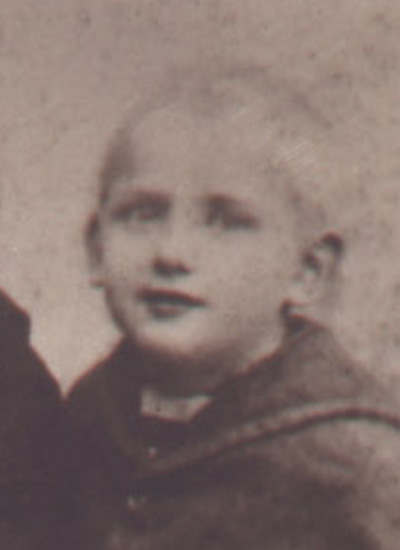
. Georg Wilhelm Fredrik Johansen. First photo taken around 1890
and the last before his death in 1960. Click here to inlarge.
My grandfather Georg Wilhelm Frederik Johansen was born in Nørrebro Copenhagen on the
22nd. September 1882 and died on the 19th. of July 1960 in Trondheim Norway. He
was originally a sailor and at one time they docked in Levanger Norway and
sailed without him because he didn’t meet the ship on time. He was and started
working as a ironworker with new construction. He married Dagny Strøm and had 3
children with her, Dagmar, Torvald and Solveig.( It was Dagmar that overtook the
“parentship” of mother’s first child and Solveig whom moved to Copenhagen.)
Dagny Strøm died at an early age of 23. There after he meet my grandmother (on
my mother’s side) Tordis Johansen whom he later married. Grandfather (on my
mother’s side) became interested in Mormans and his family was baptised within a
short time. Thereafter just about everyone on my mothers side were Mormans, also
me but I dropped out of that faith. He was a wonderful person and even after
several years later when I visited Trondheim on holiday, he remembered me, but
not as myself but as Georg’s grandchild and I always heard how good and nice he
had been.

 .
Photo of them on their silver anniversary, beside thier
marriage certificate
.
Photo of them on their silver anniversary, beside thier
marriage certificate


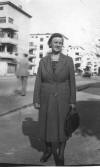


Tordis Dahl at the age of 14, 25, 30,
50, 90 and 94
Tordis Dahl was born in 1896 on 24th. January in Åsen approx. 40 km. north of
Trondheim. The house was a wooden hut with one room and a stall added on. Her
parents were poor and supported themselves with odd jobs. Her father worked on
different farms in the area, in factories and laying down railroad tracks for
Stjørdals Railway. He travelled to USA in 1905 to create a better life for his
family. He disappeared after arriving in America and no one heard anything more
from him. Her mother moved to Levanger with her children and became a laundress
to make ends meet. At the age of 10 my grandmother went to work on a farm. It
was said that she was poorly treated, she worked from 5 in the morning way into
the evening. She went to Gullberget School where she had it good there but after
school she had to work hard. At an early age she met a farmers hand – as she
said – the most quiet one she has ever seen. They got married where as she
became mother for his 3 children. She delivered him 5 children, Holger, Mary (my
mother), Gunnar, Reidar and Torleif.
She was a hard worker. She was always on the go, keeping house and if that
wasn’t enough, she helped other families that need help. She took the tram with
a basket full of cooked potatoes and some other warm food to needy families.
When she before the war got a real apartment with bath and toilet she was very
happy and had more time to help the needy. When she was 90 years old and I was
there for a visit she had to go to Levanger 80 km. away to look after a couple
of old ladies. To my question “how old they were?” so smiled and said that they
were 70 and 72 years old and couldn’t do anything themselves so she had to
helped them. She was there for a week and when she returned home she wasn’t even
tired and was ready for the next job. Within the mormon church it was said that
she was the helping committee. She lived to be 99 and she had always wished to
be the first in the family to reach the age of 100, but that didn’t happen. She
died tired and with lever cancer. Her body couldn’t any more. I didn’t have the
heart to tell her that I had found, in my research, a family member whom had
lied to be 100 years and 3 days old in 1850.
Back to genealogy
Back to start
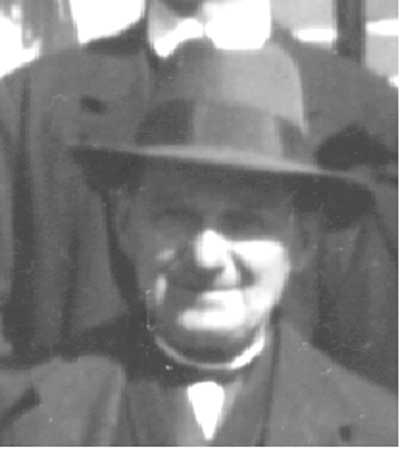 Anders Peter Andersen. The picturs was taken around 1920.
Click at the picture to inlarge.
Anders Peter Andersen. The picturs was taken around 1920.
Click at the picture to inlarge. Karoline Jørgensdatter. The picture was taken around 1920. Click to inlarge.